Monday, May 31, 2010

'Salaam' - 'Sat Sri Akal'

"Salaam," the runner wished me as we crossed each other on the trail. The salaam caught me off-guard; I was expecting the customary exchange of a smile and wave I am used to on the trail. Like some others, this runner too, going by my turban, must have mistaken me for a Muslim. The moment was too short for me to articulate a response but the earnest and sincere manner of his greeting was not lost upon my subconscious, which, reflexively, had me smiling and waving back.
Being greeted with some version of "salaam" is not new to me. On these occasions when the busyness of those moments do not allow me time for a conversation, I smile and wave back. "You are simply reinforcing their beliefs that turbaned people are Muslims," a friend confronted me once. I refuse to buy that. May be he is right; but if I have to choose between being a friendly Muslim returning a Salaam or a non-friendly Sikh miffed at being Salaamed, I would prefer the former, especially if I perceive a sincerity in the greeting.
Once, though, I did get a chance for a conversation at Stop & Shop, the grocery store. Standing in line at the check out counter, the person next to me wished me "Salaam Alaikum."

Tuesday, May 25, 2010

Marathon? Ha ha ... 43 ha ha's to you

Running a marathon is no joke; running 43 marathons in 51 days is definitely not, unless it can be perceived as a joke on the body, in which case, who better than a comedian to pull it off?
Eddie Izzard, a British stand-up comedian, more popularly known for wearing heels than for wearing running shoes, ran 43 marathons in 51 days for charity Sport Relief. What makes it a feat (no point in calling a feat 'remarkable';  isn't a feat by its very nature remarkable?) is that this cross-dressing comic is (or rather was) no athlete, and he trained for just 5-weeks before launching off into a 6-marathons-per-week schedule for 7 weeks.  "The bloke is not an obvious athlete, and thats putting it mildly," read one comment on a website.
Many of you would obviously need no introduction to Eddie Izzard; however, the unfortunate few who have not yet had their funny bone tickled by the double Emmy Award winner can look him up on youtube. This guy is hilarious.
To run or walk more than 26 miles each day is not a joke. There is only so much a body can take. But how many of us even try to assess how much this 'so much' is that we believe our bodies can take? And while the physical aspect of the run is definitely important, even more important is the psychological aspect of this feat, the will-power to get the body on the road, the mental stamina to stay on course and complete each marathon, not  just on an isolated day but each morning, day after day for 51 days. That is what sets his time on the road different from other marathoners. 
What's the significance of the numbers 43 and 51? Well, the numbers translate into 6-marathons per week for 7 weeks. But why 7 weeks? Being mathematically-challenged, I can still understand 52 marathons in a year, which translates into one marathon a week. But why 51 days? May be I am reading too much meaning into something where none exists. Perhaps, it must have been Forrest Gump-like when Eddie must have said, "I'm pretty tired... I think I'll go home now." And it simply happened to be the 43rd marathon on 51st day.

Sunday, May 16, 2010

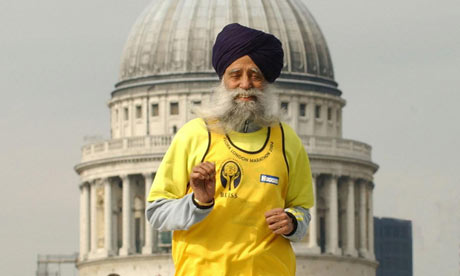
Fauja Singh: World's Oldest Half-Marathoner

Fauja Singh, who is now 99-years old, ran a half-marathon yesterday to become the world's oldest half-marathoner.

He completed the race, ING europe-marathon luxemburg, in 3:32:30 hours on May 15.
However, the star of the event was disappointed that he did not break the record for the fastest half-marathon in the M90 group (the age group of 90 & above). Currently the record is held by the Swedish Victor Burger for running it in 3:21:17 (in Gothenburg, 2002).

Fauja Singh lost 15 minutes due to an error he made on the route: he ran the route of full-marathon for some time before realizing he was on the wrong route and then headed back to the half-marathon route. This error cost him an extra 1-km, resulting in an additional 15 minutes.

The record for the oldest marathoner is held by the Greek Dimitrion Yordanidis, who in 1976 was 98 years old when he ran the 26-mile marathon in 7:33 hours. Fauja Singh is training to break that record and is considering to run the next NYC Marathon by when he would be 100.

And here I am, still groaning from the bicycle crash I had 2 weeks back.  

[Information about this event collected from this source. Pics from BBC and The Guardian]

Wednesday, May 12, 2010

Wannabe Hero

(This is the first part of the series on heroism that I intend to cover from my reading of "The Denial of Death" by Ernest Becker.)

Human beings have an urge for heroism. They seek to be heroes and are often inspired by others’ acts of heroism. They enact their heroics in the theater of the world and seek recognition of their heroism from the social world they identify with or care most about. Their social world can be large, for example, such as an individual leading an army to war or a doctor fighting global poverty and hunger. Or the social world might even be as small as their own self in which case the heroism becomes very personal and private.

Both, acts of heroism and their recognition are symbolic in nature. As per Becker, each society – nation, religion, etc – can be understood as a hero-system, a set of beliefs and values about what constitutes a hero.
“The fact is that this is what society is and always has been: a symbolic action system, a structure of statuses and roles, customs and rules for behavior, designed to serve as a vehicle for earthly heroism. Each script is somewhat unique, each culture has a different hero system. What the anthropologists call “cultural relativity” is thus really the relativity of hero-systems the world over. But each cultural system is a dramatization of earthly heroics; each system cuts out roles for performances of various degrees of heroism …” [5].
A hero-system could thus differentiate societies. Also, this implies that heroism is performed in different roles – warriors, athletes, philanthropists, scientists - and to various degrees - national or local hero, personal loss or martyrdom. Also, as per Becker, “it does not matter whether the cultural hero-system is magical-religious-primitive or secular-scientific-civilized. It is still a mythical hero-system in which people serve in order to earn a feeling of primary value …” [5]

Heroism can therefore be best understood when examined at both macro and micro level. At the macro (i.e., social) level, we would need to understand how these hero-systems are formed and how they  are sustained/changed over time. At micro (i.e., psychological) level, we would need to understand how  hero-systems influence individual behavior.

At the reflective, self-analytic, psychological level, as per Becker, “the question that becomes then the most important one that man can put to himself is simply this: how conscious is he of what he is doing to earn his feeling of heroism?

............................................................................................................
Ernest Becker. 1973. The Denial of Death. The Free Press

Saturday, May 8, 2010

You got to take chances ...

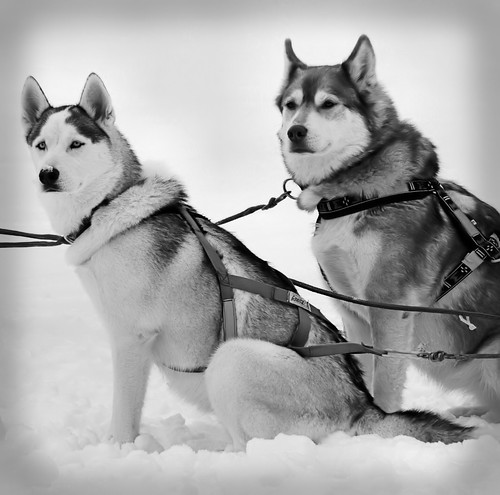
Watched Eight Under today on TV. The movie had dogs in it and my love (or call it weakness) for dogs ensured that I watched the whole movie, at times even sitting through the ads. Though the movie wasn't the same as Marley & Me (which, each time I watch it reminds me of my black lab I had in India), this one too had its moments.  
In the movie, Jerry with his team of 8 Huskies at a base in New Zealand serves as a guide to a scientist on an expedition to collect a meteorite rock. The weather makes conditions dangerous for the expedition, but the scientist insists on continuing with the expedition: "You got to take chances for the things you care about", he says.  On that journey marred by severe conditions, Jerry, with help from his dogs, twice saves the scientist's life. All make it back to the station; however, both the scientist and Jerry are injured on the journey. So the team evacuates the base and flies back to the US, leaving the 8 dogs behind for lack of room in the plane. Back in the US, Jerry wants to go back to the base to get the dogs but finds no pilot ready to fly him there. Later, a conversation with the person who had raised the 8 dogs intensifies his desire to get to the dogs. "You got to take chances for the things you care about", Jerry insists, packing for the trip. A change of heart sees the scientist and his other 2 team members join him on the expedition. The movie ends with them reaching the dogs and bringing them back.
I am such a sucker for dog movies.
...................................................................................................
A couple of must-watch videos below:

Wednesday, May 5, 2010

Moustache O'er the Handlebar

"And you should get yourself a helmet", she said looking at my turban. "Also a mirror on your bike".
I nodded. 
I had waved down the cyclist for directions to N-street but was getting more than I had asked for. I am not complaining; she turned out to be the kind of help that I could have only hoped for, not expected. Her concern was refreshing especially after my crash a couple of hours earlier where cars had passed by without stopping to offer help though seeing me fly over my bicycle handlebar. (scroll at the bottom of the post for videos)
Started out as a Beautiful Day
"N-street will take you to Beach street.  How bad is your knee hurt?"
The John Wayne in me replied, "Not so bad." The Woody Allen in me wimped, "It is better I avoid the hills."
"In that case", continued the cycling Samaritan, "you should avoid the Beech St; it has a wicked hill. I will take you around the hill, some rolling hills. Follow me." I did not want to take her away from her ride; she looked like a serious rider, lycra and all, out to have a serious ride, but she ignored my protestations and off we set to the Plaza, me trying to stay with her, the guilt of holding her back overpowering the complaints from my knee, wrist, and ribs.
The day was turning out to be not so bad after all. You almost get killed on the road and people pass you by without stopping; you stop someone just for directions and instead get offered water, energy gels, and are led to the water hole. Life has a knack for balancing itself out at the end of the day.

Saturday, April 24, 2010

Operation 'Trail Cleaning'

Weather-wise, the choice of the day for trail cleaning could not have been better. Joined the group of volunteers for cleaning the ARRT (Assabet River Rail Trail). The team started from Lincoln Street, I joined them at Hudson St and completed the section till Fitchburg St, turned back while the fellow volunteer continued, I hope, till Washington St.)
The picture on the right is one I took yesterday when running. However, today was sunny and not a single speck of cloud in the sky, as you can see in the picture below.

Monday, April 19, 2010

Today was Boston Marathon

Today was the 114th Boston Marathon and at least a couple of records were broken. Robert Cheruiyot of Kenya won the men's division (2:05:52) and Teyba Erkesso of Ethiopia won the women's (2:26:11). (trivia: no American man has won the Boston Marathon since 1983.) Cheruiyot, a 21 year old farmer from Kenya took home $150,000 and an additional $25,000 for breaking the record. "I am going to buy some cows," he said. 

Sunday, April 18, 2010

The Marriage Cookie

A popular saying in Hindi when translated means:
"Marriage is a cookie of the kind that one who eats it later regrets having eaten it and the one who doesn't eat it also regrets not having eaten it. Therefore, why not eat the cookie and regret it?"
Uh well, if research on marriage is to be trusted, it might call for revising this old adage.
An article in yesterday's issue of NYT discusses some studies on how relationships affect health and physical well-being. In general, researchers have found that:
  1. Healthy marital relationships hold the best promise for health and well-being. Married people, on an average, live longer and healthier lives than unmarried people.
  2. Unhealthy marital relationships are not good for health and well-being. "Troubled relationships can leave a person far less healthy than if he or she had never married at all  ...  if staying married means living amid constant acrimony, from the point of view of your health, you’re better off out of it".

Wednesday, April 7, 2010

Upcoming Half-Marathons in Massachusetts

   Following are links to few half-marathon races coming up this year in Massachusetts. I doubt whether I will achieve the fitness and training to run a marathon this year; but I intend to run at least one half-marathon.
And here is a link to the calendar of events for biking in Massachusetts.